
Blog
Cloud Migration Strategy: A Step-by-Step Guide for Middle Eastern Enterprises | Paramount

Designing a compliant cloud migration roadmap for Middle Eastern enterprises
Introduction
Your compliance lead flags a recent cloud deployment for violating local data residency rules. The project lead insists it passed all internal checks. Meanwhile, your audit deadline looms, and your cloud partner is asking for exemptions that don’t exist.
Middle Eastern enterprises are accelerating cloud adoption. This is evident from the fact that the global cloud market is expected to reach US$1,266.4bn by 2028 (source).
This adoption, however, is often pursued without a baseline cloud migration strategy. Migrations are approached as isolated infrastructure projects, not phased business transformations. This leads to misaligned workloads, rework during audits, and missed SLAs, especially in sectors bound by NCA, NESA, or QCB mandates.
This guide offers a practical, business-aligned approach to cloud migration for Middle Eastern enterprises. Whether you’re in banking, telecom, or government, this roadmap is designed to support compliance, optimize performance, and minimize disruption while avoiding the most common pitfalls.
Unique Cloud Migration Realities in the Middle East
Migration frameworks designed for the US or EU markets do not hold up in the Middle East. Enterprises in the region operate under layered regulations—NCA in Saudi Arabia, NESA in the UAE, and QCB in Qatar. These aren’t recommendations; they’re legally enforceable. Data residency, encrypted storage, approved vendors, and in-country backups are non-negotiable.
While global hyperscalers are expanding regional zones, many critical workloads still fail compliance for cloud migration in the Middle East. The issue often starts upstream with architectural decisions that ignore local hosting rules or encryption standards. These missteps require expensive retrofits during audits or trigger full project resets.
In this region, cloud migration cannot begin with tooling or infrastructure. It must start with the regulatory context. A compliant design is the only viable foundation for any scalable, secure migration plan.
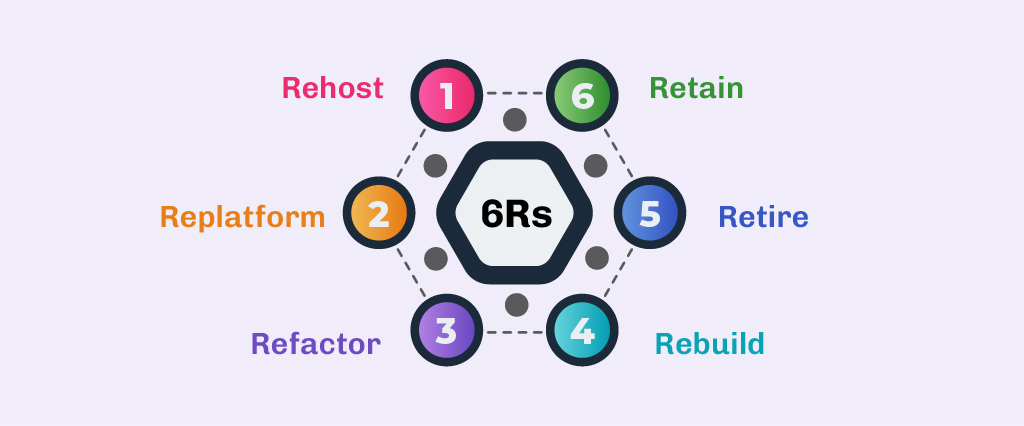
Define Your Migration Path: The 6Rs Framework
Every workload should be evaluated before migration. The 6Rs framework helps classify applications based on complexity, business value, and regulatory exposure. Without this discipline, enterprises either overspend on unnecessary reengineering or face compliance issues due to shallow refactoring.
Below are the six cloud migration strategies, adapted for regional realities:
- Rehost: Also called lift-and-shift, this moves workloads unchanged to cloud infrastructure. It’s useful for time-sensitive migrations but typically results in 20–30% higher costs due to overprovisioning. In the cloud migration Middle East context, this is often used for non-sensitive systems where compliance risk is low.
- Replatform : Involves modest adjustments—like upgrading databases or switching to managed services—without changing application code. Delivers 15–25% cost savings. Often used when applications perform well but rely on outdated components.
- Refactor:Requires architectural redesign, often using microservices or containers. This method suits high-traffic or latency-sensitive systems. While it demands longer timelines (6–18 months), it’s often essential for cloud-native migration in the Middle East, especially where encryption and isolation mandates are strict.
- Rebuild: Full redevelopment of the application using cloud-native services (e.g., serverless, container orchestration). Ideal for systems with scalability bottlenecks or poor maintainability. Not all enterprises have the internal skill sets or timelines to adopt this route.
- Repurchase: Replaces existing applications with SaaS alternatives. Common for CRM, HRMS, or accounting. The challenge lies in verifying data export capabilities and API interoperability, which is critical for meeting regional data governance requirements.
- Retire:Decommissions obsolete or redundant applications. This reduces attack surfaces and O&M costs. Legacy internal tools or duplicate systems are usually the first candidates.
- Retain: Some applications cannot move due to latency needs, vendor lock-in, or compliance constraints. Retaining them in on-prem environments is acceptable—provided there’s a defined review timeline, not indefinite deferral.
The 6Rs framework brings clarity to migration decisions. In regulated sectors, each path must be validated not just for technical feasibility but for alignment with compliance for cloud migration in the Middle East.
The Cloud Migration Phases – An Executable Roadmap
A successful migration is not one large move. It’s a phased execution with defined checkpoints, risk controls, and compliance overlays—especially in regulated Middle Eastern environments.
Here’s a five-phase roadmap tailored to cloud migration for Middle Eastern enterprises:
Phase 1: Discovery and Assessment
Begin by identifying what applications exist, their interdependencies, and readiness for the cloud. This is where most teams underestimate the complexity. Legacy systems with hardcoded IPs, unsupported OS versions, or outdated auth protocols routinely derail schedules.
Use cloud migration readiness tools like Azure Migrate, AWS Migration Evaluator, or Turbonomic to automate discovery and generate dependency maps. Don’t move forward without validating:
- Application dependencies and shared infrastructure
- Data classification and compliance for cloud migration in the Middle East
- Licensing and vendor restrictions
Phase 2: Strategy and Planning
This is where architectural decisions lock in downstream risk. Define which workloads will be rehosted, refactored, or replaced based on the 6Rs. Establish your landing zone—this includes network architecture, IAM policies, encryption controls, and logging standards.
Key planning requirements include:
- Selecting a compliant cloud model and in-region availability zones
- Establishing rollback paths and cutover windows
- Mapping business priorities against technical readiness
Phase 3: Landing Zone and Control Implementation
Before migrating any data, implement your cloud security posture. Regional regulatory mandates require you to configure:
- In-region storage zones
- Encrypted backups and key management
- Identity federation and least-privilege access models
This phase also includes policy enforcement—define logging, cost monitoring, and guardrails for workload segmentation. Failure here often leads to failed audits and retroactive remediation.
Phase 4: Migration Execution
Use practices such as:
- Pilot migrations for tool validation
- Blue-green or parallel cutovers for critical workloads
- Stakeholder alerts and helpdesk readiness before each move
Each cutover must be followed by a validation checklist: Did the application come online? Were security controls carried over? Did performance baselines hold?
Migration tools such as CloudEndure, AWS Application Migration Service, and Carbonite can accelerate this phase while reducing risk.
Phase 5: Stabilization and Optimization
Cutover is not the end. This is where most cloud migration Middle East efforts succeed or unravel.
Key activities post-migration:
- Validate encryption and IAM policies
- Check tag hygiene and cost thresholds
- Tune workloads for performance and scaling
- Align optimization with Middle East cloud migration optimization best practices
This is also the time to schedule compliance audits and finalize documentation for regulators.
Common Pitfalls to Avoid During Cloud Migration in the Middle East
Even with a sound plan, cloud migration in the Middle East fails when regional complexity is underestimated. Below are common failure points and how to address them.
| Pitfall | Consequence | Operational Fix |
|---|---|---|
| Applying Western templates without local adaptation | Misaligned with compliance for cloud migration in the Middle East; leads to audit rework or non-compliance | Map NCA/NESA/QCB mandates at Phase 1; validate with legal and GRC before tool selection |
| Skipping workload assessment | Performance bottlenecks, unsupported apps in production | Use cloud migration readiness tools to assess technical fit, dependencies, and licensing |
| Assuming “cloud-native” equals cost-effective | Unexpected cost spikes due to overprovisioned native services | Run optimization post-cutover; enforce tagging, budgeting, and Middle East cloud migration optimization practices |
| Lack of disruption planning | Downtime, failed cutovers, user escalation | Pilot migrations, rollback planning, off-hour cutovers, stakeholder alerts |
| Overreliance on foreign consultants unfamiliar with GCC norms | Misinterpreted data handling or encryption policies | Ensure advisors understand region-specific compliance and audit patterns |
Partner with Paramount for Cloud Migration Success
A single misstep—wrong region selection, unenforced encryption, or incomplete dependency mapping—can cause audits to fail or workloads to be rolled back at scale. For regulated industries, this isn’t just a delay. It’s risk exposure.
That’s where Paramount comes in. Our consultants don’t just support technical migrations. They help you operationalize a compliant, business-aligned cloud migration strategy from the ground up.
We work with enterprises across the GCC to:
- Map cloud workloads to regulatory mandates (NCA, NESA, QCB) before tooling is selected.
- Design and enforce landing zone controls, covering identity, encryption, and cost containment.
- Drive post-migration optimization across tagging, access, and region-specific tuning.
Whether you’re modernising legacy systems or scaling out new services, Paramount ensures your cloud migration delivers audit-ready outcomes, not just uptime.
Recent Posts
- IT/OT convergence a way forward towards robust OT security system
- Managed XDR
- Rockwell Automation is rocked by serious Vulnerabilities: A Comprehensive Approach to Securing Industrial Control Systems
- Cloud Data Management Regulations in the Middle East | Paramount
- Best Practices for Maintaining Regulatory Compliance in Middle East

Protect your online assets from cyber threats with Paramount
Comprehensive cyber security solutions for individuals and businesses
Significantly reduce the risk of cyber threats and ensure a safer digital environment.