
Blog
Cloud cost optimization strategies for the Middle East| Paramount

Optimizing Cloud Costs: Strategies for Efficiency and ROI
Introduction
A recent study shows that 27% of cloud spending is wasted due to idle resources, misconfiguration, and poor cost governance, adding up to $180 billion annually globally. In resource-conscious markets like Saudi Arabia, the UAE, and Qatar, that leakage undermines digital transformation and ROI objectives.
A recent study shows that 27% of cloud spending is wasted due to idle resources, misconfiguration, and poor cost governance, adding up to $180 billion annually globally. In resource-conscious markets like Saudi Arabia, the UAE, and Qatar, that leakage undermines digital transformation and ROI objectives.
Real cost efficiency requires more than rounding up unused instances. It demands that businesses break budget silos, instill cloud cost management, and shift toward highly controlled, right-sized architectures.
This article explores how enterprises in the region can reclaim cost control through governance, automation, and cultural alignment and drive cloud ROI optimization in the Middle East.
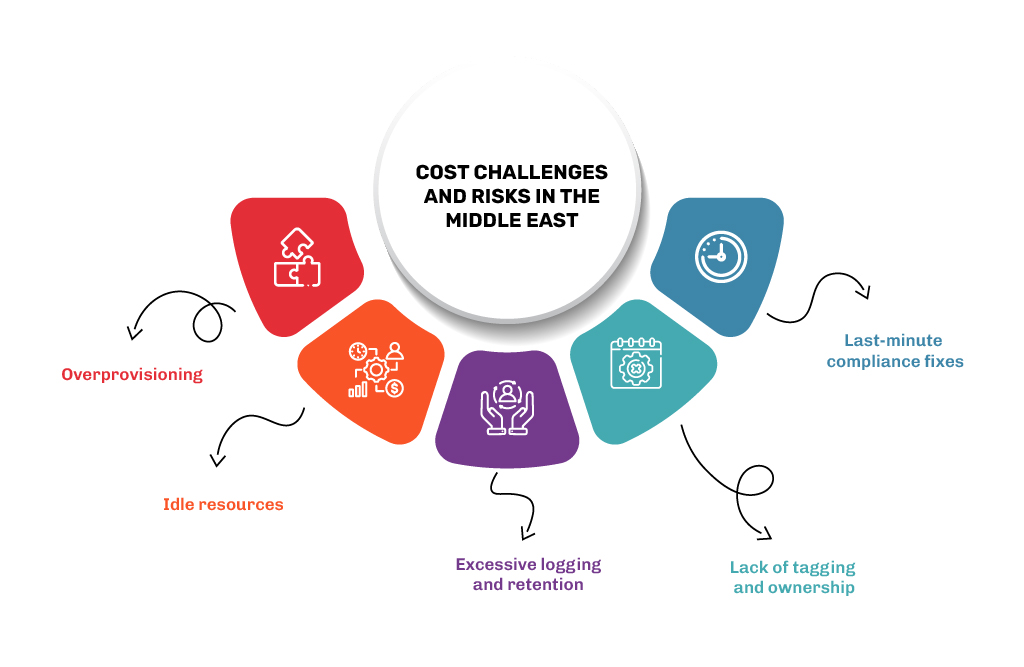
Cost challenges and risks in the Middle East
Building Integrated Cloud Cost Control Strategies
Cost efficiency in cloud environments requires discipline across governance, operations, and finance. Middle East enterprises must balance compliance demands with ROI objectives. The following integrated strategies create a foundation where compliance controls directly support cost optimization:
Build Financial Accountability with Governance Controls
Strong governance creates the visibility needed for both cost control and compliance reporting.
- Mandatory tagging – Enforce policies where no workload deploys without owner, department, and environment tags. This builds accountability and prevents orphaned resources from inflating bills while supporting cloud compliance policies auditing.
- Budgets and alerts – Define spending limits per department using integrated alerts. These same monitoring systems that track cloud data management compliance costs can prevent budget overruns.
- Chargeback reports – Monthly reports sharing usage and spending with business units foster cost-conscious behavior. These reports also demonstrate data governance in cloud investments to stakeholders.
Implement FinOps for Cross-Team Alignment
FinOps practices ensure cost optimization decisions align with compliance requirements.
- Assign cost owners – Each service must have a designated owner monitoring both usage costs and compliance obligations. This prevents regulatory gaps that lead to expensive remediation.
- Cross-functional reviews – Monthly sessions where finance, engineering, and compliance teams align spend with business value and regulatory requirements.
Common pitfall to avoid: Teams often optimize costs by reducing logging or monitoring, inadvertently breaking data classification compliance requirements in the Middle East.
Right-Size Resources to Match Compliance Needs
Optimization strategies must account for regulatory constraints while eliminating waste.
- Compliance-aware rightsizing – Assess CPU, memory, and storage utilization while maintaining data protection policies in cloud requirements. Tools like AWS Compute Optimizer help identify optimization opportunities within compliance boundaries.
- Intelligent decommissioning – Automated scans for abandoned resources must respect cloud data privacy compliance with Middle East retention requirements before deletion.
- Policy-driven data lifecycle – Apply retention policies meeting data classification laws without over-retaining. Financial logs under CBUAE requirements can move to lower-cost storage tiers after compliance deadlines, reducing costs while maintaining cloud data security policies.
Integrate Compliance Controls with Cost Management
The most effective approach links regulatory requirements directly to cost optimization workflows.
- Policy-driven storage tiering – Cloud data classification rules automatically determine storage costs. Data requiring local residency under data protection laws in the Middle East can still use cost-effective archival strategies.
- Approval workflows – High-cost services require compliance justification, ensuring regulatory needs drive spending decisions rather than competing with them.
This integrated approach transforms compliance from a cost center into a strategic advantage, where strong governance enables sustainable optimization.
Drive Sustainable Cloud ROI With Paramount
Cloud spending in the Middle East is no longer just a budgeting challenge. It is inseparable from compliance, with data protection laws in the Middle East requiring tight governance over storage, retention, and residency. Many enterprises treat these as competing objectives, but cost optimization and compliance can reinforce each other when implemented correctly.
Paramount works with enterprises across Saudi Arabia, UAE, and the wider region to embed cloud cost control strategies into their compliance frameworks. Our teams align resource tagging, budgeting, and FinOps reviews with obligations under cloud compliance regulations (Saudi PDPL) and cloud compliance regulations (UAE DIFC DP Law). We also design data lifecycle and residency controls that reduce storage costs while maintaining audit readiness.
By integrating cost management with security and regulatory requirements, Paramount enables clients to achieve cloud ROI optimization in the Middle East without compromising compliance. From multi-cloud cost analysis to workload rightsizing, our approach ensures every investment is justified in both business and regulatory terms.
Recent Posts
- A Step-by-Step Guide to Choosing the Right MSS Provider in the Middle East
- The 3W’s of Cybersecurity Frameworks – What, Why, and When
- How to Detect and Prevent Deepfake Attacks in Cybersecurity
- Think You’re Safe? Your Cybersecurity Assessment Might Say Otherwise.
- Clearing the Air on Cloud Security: Myths, Facts, & Benefits

Protect your online assets from cyber threats with Paramount
Comprehensive cyber security solutions for individuals and businesses
Significantly reduce the risk of cyber threats and ensure a safer digital environment.