
Blog
Reverse Mentorship: What Leaders Gain When They Listen

Early in my leadership journey, I believed growth came primarily from mentors who were ahead of me. Over time, I realized some of my most important leadership lessons came from those earlier in their careers.
From the questions they asked.
From the discomfort they voiced.
From the realities they navigated quietly.
That is when I understood that mentorship does not only move downwards. Sometimes, the most transformative leadership growth happens in reverse.
This International Women’s Day, as we get into the spirit of “Give to Gain,” there is another dimension we must acknowledge: when leaders give space and attention to those at different career stages, they gain insight, relevance, and better decision-making in return.
A recent study attributed 67.9% of employee performance improvement to reverse mentorship, highlighting how structured cross-level dialogue strengthens capability on both sides. Performance improvement at that scale does not happen by accident. It happens when experience meets emerging perspectives. Reverse mentorship works because it reconnects leadership with context. And context is what keeps decisions relevant, inclusive, and future-ready.
Why Senior Leaders Need Exposure to Lived Realities
As careers progress, proximity to frontline experience naturally decreases. Decisions become more strategic, conversations more structured, and time more compressed. While this evolution is necessary, it can also create invisible gaps.
Reverse mentorship bridges those gaps.
It exposes leaders to the lived realities of women navigating different career stages: early ambition, mid-career inflection points, caregiving responsibilities, digital overload, evolving expectations around flexibility and purpose. Listening in this context is not a courtesy. It is a calibration tool.
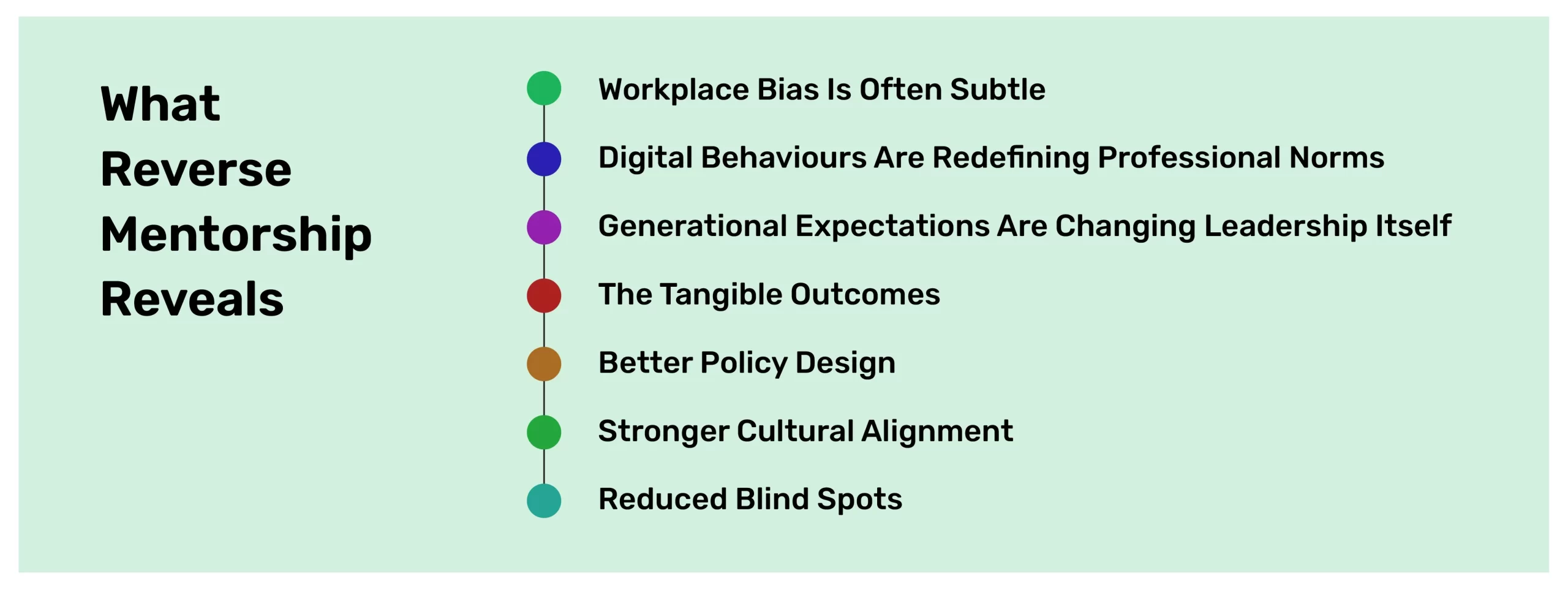
- Workplace Bias Is Often Subtle
Bias does not announce itself loudly. It appears in small exclusions, interrupted voices, assumptions about availability, or uneven access to stretch assignments. Through reverse mentoring conversations, leaders begin to see how micro-experiences shape macro outcomes. These insights reduce blind spots and help shift from reactive correction to proactive design. - Digital Behaviours Are Redefining Professional Norms
Younger professionals operate in a digitally fluid environment. Feedback cycles are faster. Visibility is continuous. Boundaries are negotiated differently. Understanding these shifts helps leaders rethink communication norms, recognition practices, and engagement models. It ensures that culture evolves alongside technology rather than resisting it. - Generational Expectations Are Changing Leadership Itself
Today’s workforce is not simply asking for advancement. They are asking for alignment between performance and well-being, ambition and flexibility, contribution and meaning. Reverse mentorship allows leaders to understand these expectations before they manifest as attrition. The result is better succession planning, stronger engagement, and more thoughtful leadership pipelines. - The Tangible Outcomes
When reverse mentorship is embedded intentionally, the gains are measurable. A Harvard Business Review study found that organizations with structured reverse mentorship programs reported a 96% retention rate among millennial mentors over three years. Reverse mentorship is thus a retention strategy, a culture strategy, and a leadership relevance strategy rolled into one. - Better Policy Design
Policies shaped with real employee input are more adaptive and more credible. Whether it is hybrid frameworks, parental support, return-to-work programs, or evaluation criteria, lived insight strengthens execution. - Stronger Cultural Alignment
When leaders actively listen across levels, they reduce the invisible gap between intent and impact. Employees feel seen, not managed. This increases trust, strengthens engagement, and improves retention because culture feels responsive rather than imposed. Alignment improves not through messaging, but through mutual understanding. - Reduced Blind Spots
Every leader has areas they cannot see alone. Reverse mentorship acts as a mirror. It surfaces assumptions, highlights unintended impact, and sharpens decision-making before misalignment becomes systemic.

Reverse mentorship is not about reversing hierarchy. It is about strengthening leadership. The future will not be shaped by leaders who speak the most. It will be shaped by those who listen the deepest.
If we truly believe in “Give to Gain,” we must recognize that when leaders give attention, humility, and space to learn, they gain relevance, resilience, and long-term trust. When we choose to learn across levels, we all grow stronger together. The question then becomes: what does the next chapter of reverse mentorship look like?
Where Reverse Mentorship Goes From Here
As organizations look ahead, reverse mentorship is likely to evolve beyond traditional one-to-one conversations.
We may begin to see it emerge in new forms – cross-industry learning, observation-based insights, innovation-driven exchanges, and even process-focused mentorship where leaders study how other sectors build engagement, collaboration, or frontline experience.
Some of the most valuable lessons come from contexts very different from our own. What can a technology leader learn from industries where workforce realities, operating environments, or education levels look entirely different? What insights can emerge simply from observing how innovation happens in creative teams or how collaboration unfolds in high-performing groups?
These perspectives broaden the idea of mentorship itself.
For organizations considering reverse mentorship, the next step is to approach it intentionally. Adoption matters: how frequently such exchanges occur, how many leaders participate, and how consistently conversations are sustained. Engagement matters too, not just the number of interactions, but the depth and quality of dialogue.
Organizations must also track cultural indicators such as engagement among younger employees, participation across career levels, and the learning that emerges from these exchanges.
Ultimately, the real measure of reverse mentorship lies in what it changes. How leaders think, how organizations listen, and how decisions reflect the realities of the people they impact.
Mentorship has always been about learning. Reverse mentorship simply reminds us that some of the most important lessons may come from places we did not initially think to look.
So the question for leaders today is simple:
Are we ready to listen?
ABOUT AUTHOR

Divya NT

Divya N T, Chief Officer of Employee Experience and Fulfillment at Paramount. Divya has been a cornerstone of Paramount for 18 plus years, spearheading employee experiences and community relations. With expertise in talent acquisition, employee engagement, and corporate strategy, she has played a crucial role in strengthening workplace culture and fostering transparency. "Leadership is not about fitting into a mold; it’s about shaping the space you step into. The moment you embrace your strengths unapologetically; you redefine what’s possible for yourself and others."

Protect your online assets from cyber threats with Paramount
Comprehensive cyber security solutions for individuals and businesses
Significantly reduce the risk of cyber threats and ensure a safer digital environment.