
Blog
3 Reasons Your Cybersecurity Strategy Isn’t Working—And How to Fix It

3 Reasons Your Cybersecurity Strategy Isn’t Working—And How to Fix It
Cybersecurity spending in the Middle East and Africa is forecast to reach $8.4 billion in 2027, representing a CAGR of 12% between 2023-2027. Despite record-level investments, many Middle Eastern organizations continue to suffer from high-impact breaches. In 2023, the total cost of a data breach in the region reached SAR 29.9 million, a 15% increase over the last three years.
While companies are investing in enough in cybersecurity, the problem is, those investments don’t always line up with what the business actually needs. In many cases, there is a disconnect: security teams push tools and protocols, but they don’t always reflect how the organization runs day to day. The result? Well-intentioned programs that look good on paper but fall short when a real threat hits.
Here are three critical reasons why your cybersecurity strategy might be falling short and what you can do to fix it.
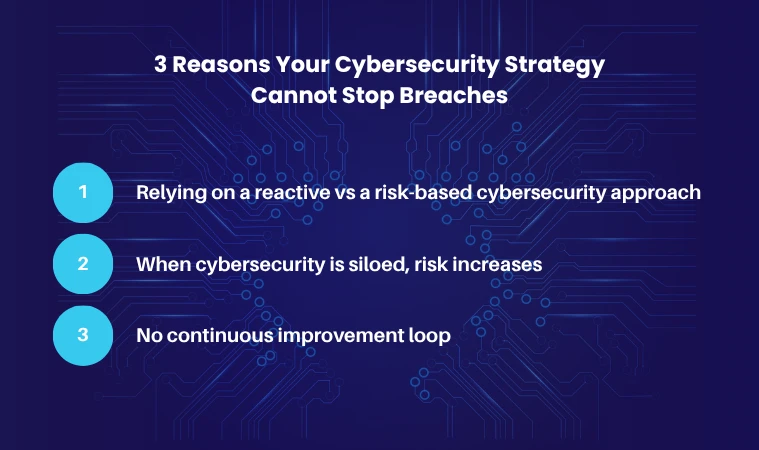
3 Reasons Your Cybersecurity Strategy Cannot Stop Breaches
1. Relying on a reactive vs a risk-based cybersecurity approach
One of the most persistent problems is the tendency to treat cybersecurity as a regulatory necessity rather than a strategic business function. A survey by Delinea that encompassed IT security decision makers found that 63% of respondents in UAE and KSA did not think that their boards considered cybersecurity as a business enabler. This results in:
- Security programs designed to pass audits, not mitigate actual threats.
- Investments delayed or misdirected
- Resources wasted on tools that don’t directly reduce risk
Surprisingly, many companies are still depending on perimeter firewalls or a framed ISO certificate for security, without putting real effort into detecting threats inside the network. A well-crafted phishing email, social engineering, or a remote access tool disguised as something harmless is all it takes. These kinds of threats don’t show up on checklists and they’re usually halfway in before anyone notices.
As cybersecurity experts increasingly recommend, the focus must shift “from cybersecurity to cyber resilience”—prioritizing damage control and recovery just as much as. Resilience means having the right incident response teams, tested playbooks, and executive involvement in breach scenarios—not just policies on paper.
The solution
- Adopt a formal risk-based cybersecurity framework
- Conduct a business impact analysis to map critical assets and vulnerabilities.
- Prioritize investments around actual business risks—not just audit points.
- Use this framework to guide your cyber crisis management plan and implement a data loss prevention strategy that addresses both regulatory and operational realities.
2. When cybersecurity is siloed, risk increases
Cybersecurity can’t function effectively if it’s confined to the IT department. Without broader engagement from leadership, operations, legal, HR, and even marketing, security efforts lack traction and often fail to gain the visibility needed for real impact.
This siloed approach creates a dangerous gap: security teams may believe they’re prepared, while the rest of the organization remains unaware or unaligned.
The solution
- Reposition cybersecurity as a cross-functional strategic priority.
- Bring security into boardroom discussions, not just IT reviews.
- Use business language to communicate risk, continuity, and reputational impact.
- Collaborate with regional experts—such as cybersecurity consulting firms—to tailor strategies to both business objectives and local compliance landscapes.
3. No continuous improvement loop
Too many cybersecurity strategies are designed as one-off projects—deployed and forgotten. But the threat landscape changes constantly, and a static approach leaves businesses exposed. As AI-driven attacks, hybrid-cloud risks, and complex regulatory mandates evolve, cybersecurity strategies must evolve too. Yet many organizations lack
- Outdated KPIs that don’t reflect today’s threat landscape
- Lack of regular cybersecurity strategy reviews or incident-driven learning loops
- Minimal governance around AI tools now embedded across enterprise workflows
Without a continuous improvement loop, even the best-funded cybersecurity programs risk becoming obsolete. Resilience demands ongoing adaptation, not just upfront investment.
The solution
- Embed a continuous review cycle into your cybersecurity program.
- Monitor KPIs like detection time, response time, and policy adoption.
- Integrate an AI governance framework to ensure model transparency, training data quality, and ethical usage.
- Prioritize responsible AI governance to reduce the risk of bias, automation misuse, or hidden attack vectors.
- Encourage cross-functional feedback after each incident to refine controls and improve response.
Bringing Cybersecurity Strategy to Life with Paramount
Across the Middle East, many organizations have clear cybersecurity plans on paper—but struggle to turn them into practical, working systems. That’s where Paramount steps in. Drawing on years of experience in sectors like finance, government, and telecom, Paramount helps teams move from broad strategy to day-to-day execution—whether it’s mapping risk across critical assets or walking leadership teams through live crisis simulations.
Having worked closely with frameworks like SAMA, NCA, TDRA, and ADGM, Paramount understands the nuances of compliance in the region—and how to make those requirements work for the business, not against it. The focus is simple: build cyber programs that reflect local realities, adapt to change, and actually hold up under pressure.
Get in touch to design and execute cybersecurity strategies that align with your business, regulators, and risk reality.
Recent Posts
- Preparing for AI in Cybersecurity: A Strategic Guide for Businesses
- Everything You Need to Know About Passwordless Authentication
- Why is choosing the Right Security Operations Center Necessary?
- The Most Critical Cyber Threats Middle East Businesses Face
- Generative AI adoption risks you should address to safeguard your enterprise

Protect your online assets from cyber threats with Paramount
Comprehensive cyber security solutions for individuals and businesses
Significantly reduce the risk of cyber threats and ensure a safer digital environment.